
Breed Standard of Excellence
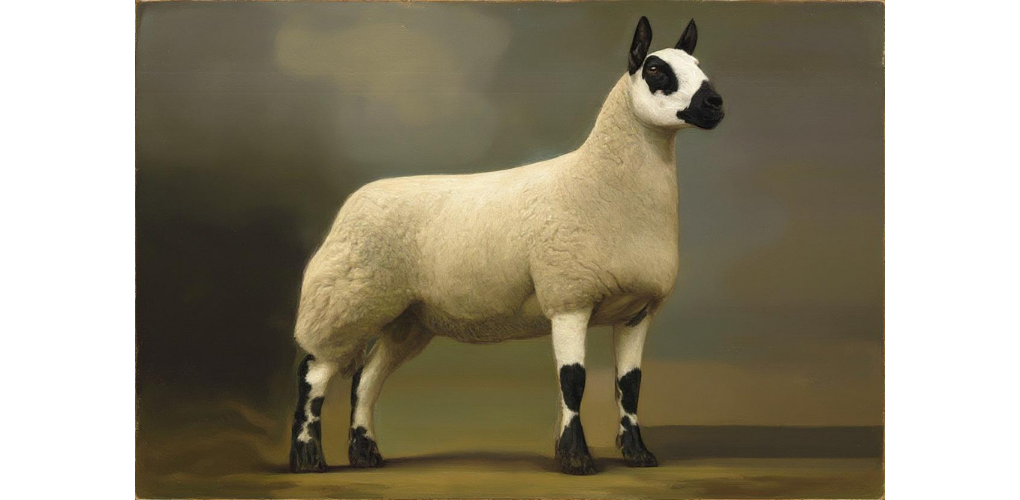
The Kerry Hill is distinguished for their striking breed character. The general appearance should be alert, erect, and expressive.
The ram should exhibit obvious masculinity, a strong, broad head; bold expression; and a powerful, well-balanced frame.
The ewe should show greater refinement through the head and neck, with smooth femininity and correct angulation. She should lamb easily, provide ample milk, and display strong mothering instincts.
Head
The head is the defining hallmark of the Kerry Hill. It should be held proudly and carried high. The face must be white with sharply defined black markings, including black patches around the eyes and at the muzzle. These markings should be clear and symmetrical, giving the breed its distinct, bright-faced expression. An odd black spot on the face is acceptable.
Ears
The ears are medium in length, set high, and carried erect. They should be free from wool and may be black, black and white or white.
Neck and Throat
The neck should be strong and muscular, well set into the shoulders. The throat should be nicely curved and wooled, with no loose skin.
Teeth
Incisor teeth must bite on all inner surfaces. They must not be overshot or undershot.
Feet and Legs
Feet and legs should be strong, straight with good width. Legs should present wide and square, showing proper angulation at the hock and firmness in the pasterns.
The Kerry Hill should stand with confidence, carrying its body weight evenly. Excessive wool on the inside of the upper forelegs, upper inside hind legs, and around the crotch or scrotum is discouraged.
Hoof color should be black or predominantly black with minimal white striping. The hair on the legs must display strong black markings, consistent with the breed’s distinctive look. While patterns may vary from sharply defined to slightly speckled, the color should relate closely to the dark pigment seen on the muzzle, and it is acceptable for the leg markings to be darker or more pronounced.
Back and Loin
The back should be long, straight, and strong, maintaining a level topline from the shoulders to the dock. Muscling should appear natural, smooth, and symmetrical. Animals that display extreme or blocky muscling of the rack, a noticeably shortened loin, are to be discriminated against, as such traits are not in keeping with traditional Kerry Hill breed character or functional soundness.
Hindquarters
The hindquarters should be wide, deep and well fleshed to the hocks.
Testicles
Testicles should be the same size with minimal wool.
Size
Kerry Hills are a medium-framed, well-balanced breed, noted for their stylish appearance and proportional build rather than extreme size. Animals should maintain the characteristic Kerry Hill silhouette, upright carriage, clean lines, and symmetry of frame.
A yearling ram in working flesh normally ranges from 180–240 pounds, depending on management and environment, with ewes typically weighing 130–180 pounds as yearlings.
While frame size may vary across breeding programs, breeding stock should remain longer than tall, maintaining a balanced, rectangular profile. Selection for structural correctness and overall length should support steady genetic progress without producing coarse, overly large animals.
Rams should stand approximately 30–33 inches at the shoulder, with ewes averaging 26–30 inches. These measurements reflect the breed’s moderate yet purposeful build.
Fleece and Hide
The fleece should be dense, close, and uniform across the entire body, with a firm yet springy handle. Kerry Hill wool is traditionally of medium quality, and the fleece should be free of kemp, coarse fibers or open patches.
Preferred fleece quality typically ranges from medium to medium-fine, with spinning counts in the 50s to low 60s, with fiber diameters commonly around 28–34 microns, consistent with the traditional wool classification of the breed.
The skin should be pink or red in color, free of blue or black spots or tint. While some moderate speckling on the hide is acceptable, excessive pigmentation or large dark patches are discouraged. Wrinkling of the skin is not desirable, as it interferes with uniform fleece growth and detracts from the clean, even appearance expected of the breed.